2 Comments

Murders over Money: Bethune Cookman Tragedy

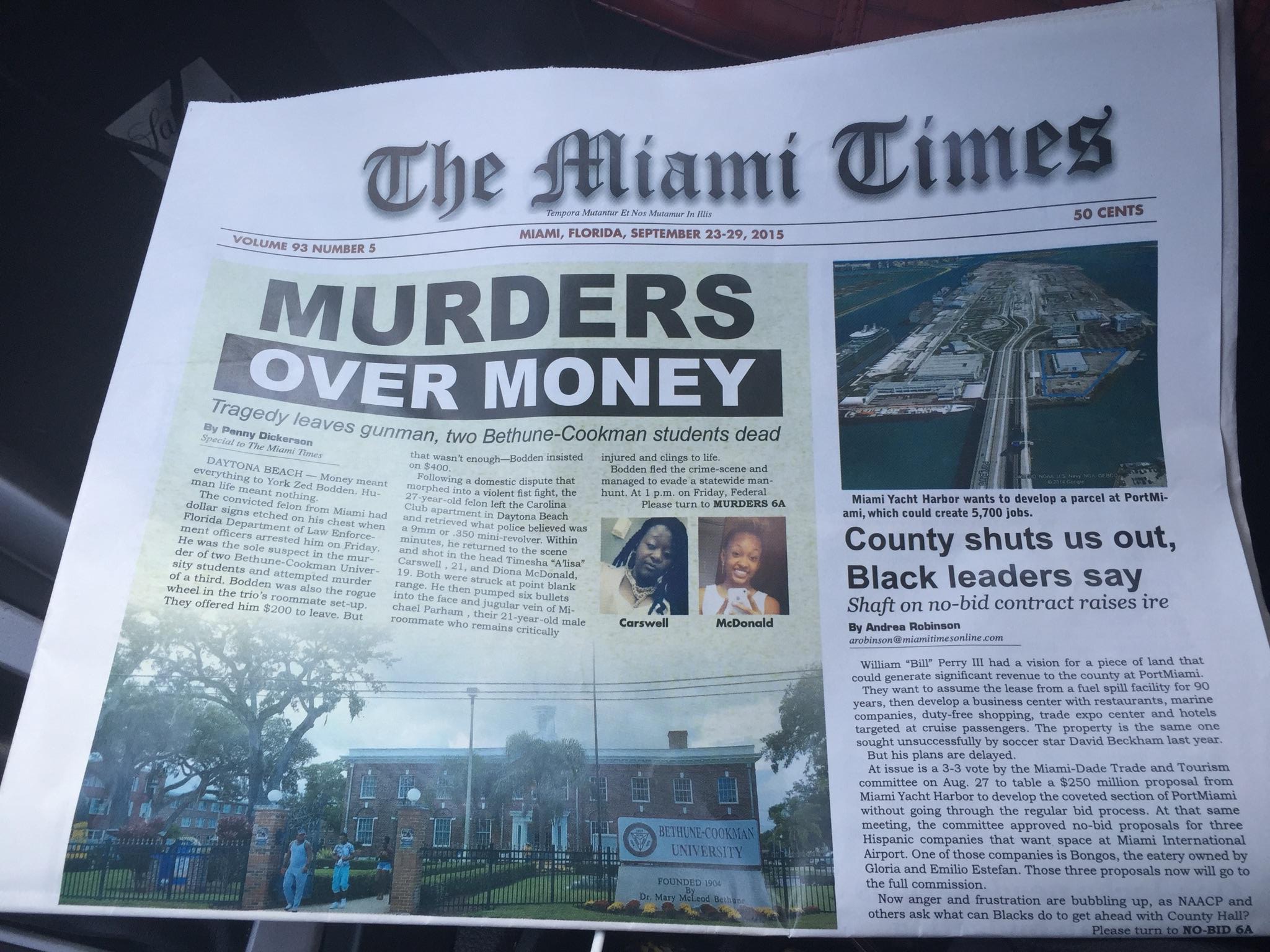
Miami Times Front PageMurders over money

Tragedy leaves gunman, two Bethune-Cookman students dead

Penny Dickerson | 9/23/2015, 2 p.m.
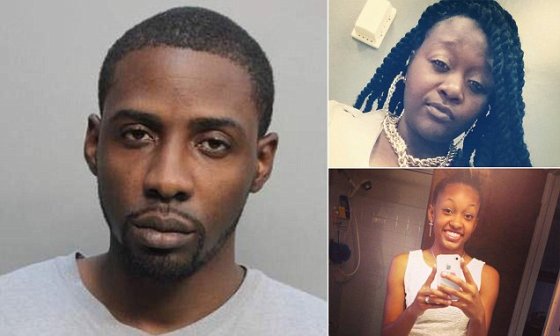
York Zed Bodden

“Murders Over Money” Miami Times Online

DAYTONA BEACH — Money meant everything to York Zed Bodden. Human life meant nothing.

The convicted felon from Miami had dollar signs etched on his chest when Florida Department of Law Enforcement officers arrested him on Friday. He was the sole suspect in the murder of two Bethune-Cookman University students and attempted murder of a third. Bodden was also the rogue wheel in the trio’s roommate set-up. They offered him $200 to leave. But that wasn’t enough—Bodden insisted on $400.

Following a domestic dispute that morphed into a violent fist fight, the 27-year-old felon left the Carolina Club apartment in Daytona Beach and retrieved what police believed was a 9mm or .380 mini-revolver. Within minutes, he returned to the scene and shot in the head Timesha “A’lisa” Carswell, 21, and Diona McDonald, 19. Both were struck at point blank range. He then pumped six bullets into the face and jugular vein of Michael Parham, their 21-year-old male roommate who remains critically injured and clings to life.

Bodden fled the crime-scene and managed to evade a statewide manhunt. At 1 p.m. on Friday, Federal law enforcement agents arrested him at a North Miami apartment. The next day, his short-lived life ended. Prisoner #150020036 was found hanged in the K-28 section of the Turner Guilford Knight Correctional Center in Miami-Dade.

The three shooting victims were music majors from Michigan. McDonald is a Detroit native and Carswell and Parham are from the neighboring town of Inkster. Carswell was dating Bodden who authorities confirmed had been living with a Daytona Beach State College student just one week earlier. A criminal motivated by money, Bodden’s victims lived honorable lives that were the polar opposite:

“There were no signs of drugs or (drug) money anywhere in the house or in the student’s cars,” Chief Michael Chitwood of the City of Daytona Beach Police told the Miami Times. “Every one of those students were good young men and good young women who’ve never been in trouble with the law. They were good students and well respected at Cookman, so that’s what makes this really difficult. These are kids that had a brilliant future. These are kids that would be the future of what America is all about,” he added.

DOMESTIC DISPUTE

The bedrock of communication is rooted in conflict-resolution, but for college roommates who realize, “things weren’t working out,” even a voice of reason wasn’t enough to intervene.

“Micah and Timesha felt it wasn’t going to be pretty when they asked him [Bodden] to move out, so they asked their classmate Sidney Washington of Oklahoma if he could come over and lend some support,” said Chitwood.

“And they were right. When they asked him to leave, a big fight erupts between Micah and our shooter. It got so violent that Mr. Washington armed himself with a knife and you can see in the back room that somebody got shoved through the wall because all the sheet rock was busted, so it was a physical fist fight first.”

 A conciliatory agreement ended the brawl and Bodden went as far as to shake hands with both men. But none of the students could have been prepared for the fatal events that followed when Bodden returned. And police were not prepared to discover a crime scene that revealed how the students ran for their lives.

One female victim was found dead at a closet entrance. The other was on a bedroom floor. Parham was initially shot in a closet, but made his way to the kitchen floor. Washington tried to overtake the shooter, but ultimately dodged death by jumping through a first-floor window. He escaped harm.

FELONS WITH GUNSBCU Campus from Bethune Blvd

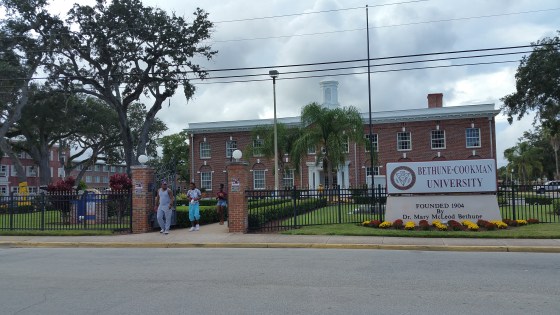
The tragedy took place off-campus and almost five miles away from Bethune-Cookman. The university is an institutional jewel that is rich in Southern heritage and seeks to develop students who enter to learn and depart to serve. Carsell and McDonald both departed before their time and at the hands of a felon who never should have been in possession of a gun.

These brutal murders mark the ninth gun-related crime at Bethune-Cookman in the past seven months. Previously, nine students were wounded—this time two students and a shooter are dead. Amplified is Florida’s existence as a fledging “Gunshine state” that continues to search for law enforcement and criminal justice solutions to curb gun-related crimes.

“How do you stop somebody, especially in our society that is so pro-gun everything? You can’t stop ‘em from getting a gun. Especially here in Daytona Beach,” said Chief Chitwood. “All you gotta do is drive into a parking lot and see an F-150 flying the rebel flag and you can rest assure there’s a gun in there. He’s got his bumper sticker screaming ‘I love the NRA’ and ‘Long live the second amendment,’ and that’s what the bad guys break into. They get guns that way.”

BODDEN’S RAP SHEET

York Bodden

York Bodden may have died in a damp county jail, but he left a legacy of felony arrests and convictions that began eight years ago and continued in three-year increments.

• 10/26/2007 False Imprisonment.

• 10/26/2007 Felony Battery

• 04/16/2010 Burglary of an occupied dwelling

• 04/16/2010 Burglary of an unoccupied structure

• 09/17/2015 Capital Murder in the first-degree and aggravated assault.

• 09/19/2015 Felony Suicide

Had he not hanged himself, Chitwood’s recommendation would have been life in prison.

“Part of me is a death penalty advocate and part of me isn’t. He should (have) sat in that jail cell and rot the rest of his life away thinking of what he did to those families,” said Chitwood. “Whatever it was to be, his days of being free and able to hurt anyone else should be done….life in prison may even be too good.”

At press time, the Miami Times was unable to contact Bodden’s next of kin for comment.

Meanwhile Walter Clark, president and CEO of Special Consultant for African-American Government Employees (SCAAGE), is questioning why an inmate in transit ended up dying in police custody.

“The prisoners are not being supervised properly,” Clark said. A similar situation happened to an inmate that was in transit at the jail. They are not equipped to take care of unruly prisoners.”

EXEMPLARY YOUNG WOMEN

Both McDonald and Carswell are B-CU music majors who were active in the university choir and described as “kindhearted girls.” They were exemplary students who both had a parent precede them in death. McDonald’s mother died of breast cancer just months ago and Carswell’s father succumbed to cancer when she was three.

“I hope to God, in my lifetime, I never know the pain that those parents know because I don’t know if I would be able to live in the shoes they’re in, especially Mr. McDonald,” shared Chitwood, whose own daughter is a college senior at a separate institution. He finally allowed her to move off campus this year, but after these shootings, he regrets that decision.

Prayer vigils were held on campus the day following the students’ tragic deaths. The Miami Times spoke with Ira Johnson, the uncle and pastor of Carswell. It was his family who raised his deceased niece after her father [Tim] Carswell died:

“She always called me “Uncle Ira J” and the whole family called her “Lisa.” She was always smiling and such a great spirit,” Johnson shared. “ We have a huge family, but Lisa was the heart and soul of the family. She was an encourager. After the Charleston shootings, she went on Facebook and lifted up other cousins by saying, ‘Don’t worry Cuz, it’s gonna be alright. She would often call and say ‘I love you’ for no reason,” Johnson added.

BETHUNE COOKMAN STATEMENT The office of president Edison O. Jackson released the following response last week:

“It is with saddened hearts that Bethune-Cookman University announces the loss of two students and the critical injury of a former student. The students were victims of a fatal domestic violence incident that occurred at a privately-owned apartment complex in Daytona Beach, Florida early Thursday afternoon.

Bethune-Cookman University’s first priority is the safety and wellbeing of the students. We will continue to communicate and educate the BCU family about domestic violence and general conflict resolution.

Our Department of Public Safety is readily available to assist all students who are in need of conflict mediation and security services. In addition, personnel in Counseling Services are available for grief counseling. This is a very unfortunate incident and our thoughts and prayers are with the families, loved ones and fellow classmates of these students.”

Surviving student Parham remains in intensive care at Halifax Regional Hospital. Chitwood is expected to launch a campaign in the coming days for donations in the form of gift cards to restaurants that will be extended to Parham’s family. They arrived from Michigan and have remained at his bedside since last Thursday.

2 Comments

LeVar Burton talks “Roots & Digital Rainbows”

florida-courier-logo

Filed under ENTERTAINMENT, METRO

LeVar Burton speaks exclusively to the Florida Courier in advance of his November appearance at Rollins College in Winter Park.

BY PENNY DICKERSON
FLORIDA COURIER

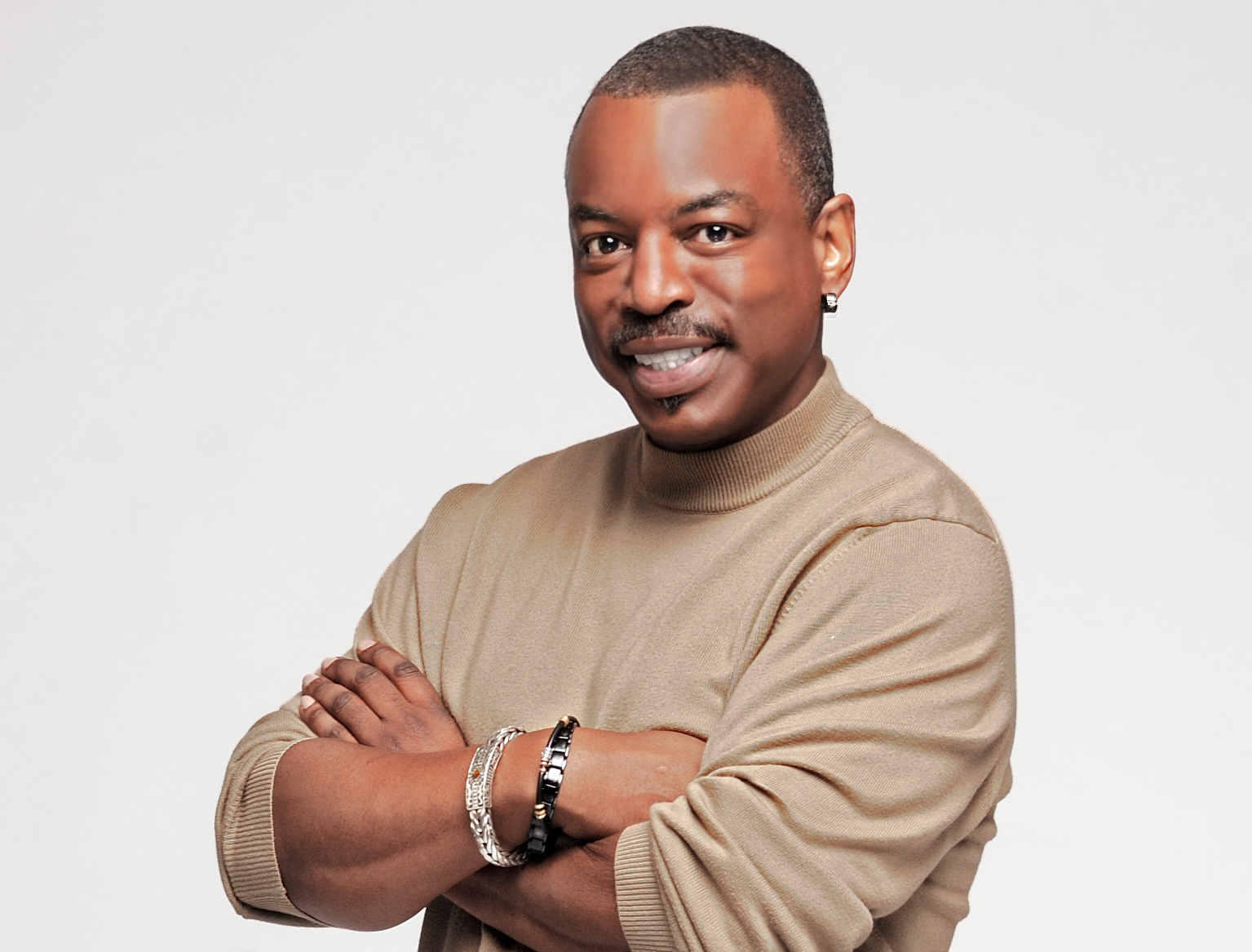
LeVar Burton is best remembered in the archives of American culture for his debut  in the 1977 mini-series “Roots.” In his first audition and role, the 19-year-old was cast as Kunta Kinte, the wide-eyed Mandinka warrior who fled slave masters with the speed of a wild gazelle.Levar Burton High Res Head Shot

Burton’s character not only personified rebellion, he made it look cool. He was a hero who gave Blacks nationwide a license to cheer for their own identity and freedom. Continue Reading »

Leave a comment

Fist pound to a Haitian poet

Enzo Silon Surin’s new collection is a voice to save Black boys.

Penny Dickerson

 Updated 

Miami Times

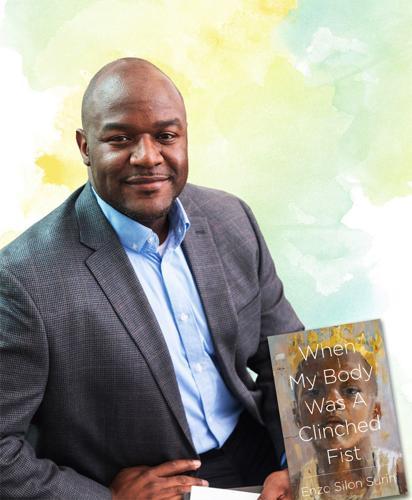
Enzo Silon Surin

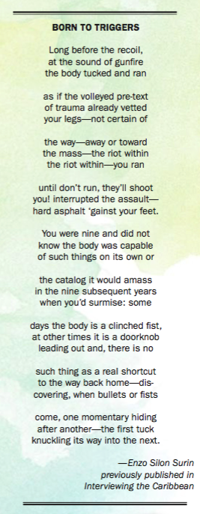
“Young black boys suffer a great deal from PTSD and consequent mood disorders as a result of the type of violence they are exposed to. Instead, what we mostly get is a perspective that portrays such young boys as active or potential perpetuators. I believe being able to name an experience and putting it into a context that one can understand is both validating and empowering.”

-Enzo Silon Surin

The Revolving Door Reading Series: Online Edition Part III kicked-off at 8:00 p.m. sharp in a grid-view on Zoom. In this era of shutdown that defies the new normal, artistry prevails, friends continue to gather and poets show up. Some showed out like Ebony E. Chinn, a freelance copy editor from New Jersey who welcomes forthcoming publications on Callallo. A Salvadorian-American poet from Inglewood, CA and managing editor who answers to the name Cynthia Guardado read her ethnic insights and there, too, was Chicago poet, Lisa Farver.

But closing out the night was a quiet giant who waited patiently. His head glistened under light and he donned a tailored jacket that offered a glimpse of an Eddie Bauer t-shirt, if your perception was keen. My instincts were stoked. I waited in anticipation, but not like a giddy fan. It was simply out of respect to witness the literary manifestation of why poets bring pen to page.

Enzo Silon Surin did not disappoint. The Haitian-born poet, artist, publisher and social advocate is author of When My Body Was A Clinched Fist (Black Lawrence Press, July 2020), and the chapbooks, A Letter of Resignation: An AmericanLibretto (2017) and Higher Ground (2006). He is a PEN New England Celebrated New Voice in Poetry, the recipient of a Brother Thomas Fellowship from The Boston Foundation and a 2020 Denis Diderot [A-i-R] Grant as an Artist-in-Residence at Chateau d’Orquevaux in Orquevaux, France. Surin’s work gives voice to experiences that take place in what he calls “broken spaces” and his poems have been featured in numerous publications and exhibits. He holds an MFA in Creative Writing from Lesley University and is currently Professor of English at Bunker Hill Community College and founding editor and publisher at Central Square Press.

Enzo, too, is a language beast. A rhythmic master. A storyteller to reckon and after interviewing him for The Miami Time on Friday, April 24, I can personally attest that he personifies transparency. We talked the delicate matter of Black boys and dealing with mental health and anxiety, being a Brown Haitian in Black America, and how he eventually opened a clinched fist to become a loving husband and father of two boys who exudes the sensitivity he never knew as a child, but realizes it is as necessary to life as breath. Here’s what he shared in our four-question exchange:

PD: I’ve read it has taken you ten years to pen your upcoming collection, When my body was a clinched fist that will debut in July 2020. What served as the motivator to continue creatively until you reached the finish line?

Enzo: Whether I wanted to or not, my body was already telling a story about my experiences and that story would have remained trapped unless I released it. As someone who spent most of his youth and adult life grappling with anxiety,  it was not a complicated decision to make but it surely was one of the toughest decisions of my life. Writing about my experiences meant I had to relive each and every single one of them. As a result, I had to create safe spaces for myself and also proceed at a safe pace—having to walk back down streets I had spent years paving with a pen did not make necessarily make them any safer. 

That being said, the reason why I worked so hard and for so long to cross the finish line, chiseling away at these poems, is because one day when someone happens to read said poems they might feel seen and heard in their own struggle to overcome similar situations. I want them to feel, even for a minute or two, that this thing called life is worth the hard and long chisel and that they too are worthy of such a dedication.

PD: When my body was a clinched fist is metaphorical in that you have evolved from the restraints — the streets — of adolescence into a creative force who appears quite comfortable in his own masculine skin. Tell The Miami Times how your writing process and poetic indulgence helped both evolve.

Enzo: Poetry allows us to provide what Ken Burns refers to as a “safe harbor to express our emotions.” Being both introverted and a sensitive black youth presents a far greater challenge to navigate the perilous streets of one’s life. I spent a good amount of time not just avoiding the violence but also trying to protect myself emotionally. And it was very difficult to balance the two worlds.

Society doesn’t often provide the perspective that young black boys suffer a great deal from PTSD and consequent mood disorders as a result of the type of violence they are exposed to. Instead, what we mostly get is a perspective that portrays such young boys as active or potential perpetuators. I believe being able to name an experience and putting it into a context that one can understand is both validating and empowering.

PD: Why is this collection of poems such an important reference and voice for young Black boys who have chosen to abandon violence? How can it help those who resist peace?

Enzo: When My Body Was A Clinched Fist is an interjection in the conversation about what happens to sensitive black boys in a very tough environment, especially those who choose to walk away, as recommended, and not contribute to or participate in the violence they face every single day. They become members of a subculture of society that does not receive much support or recognition for the challenges they face by making that decision. As such, they grapple with mental health issues of a different caliber, one that doesn’t manifest itself as profoundly as a strike or blow but is traumatic nonetheless. The toughest part is always walking away, finding fifty different ways to not expose oneself to the rain is not an easy task when you live in a climate prone to precipitation.

PD: How important is your Haitian heritage in the advancement of your creative voice?

Enzo: Haitians don’t shy away from difficult conversations. There is no other direction that Haitians know to move forward than that of moving forward. There is so much still going on in Haiti and our community is connected to that political structure. We are still connected to fighting two different forces. America only has to worry about America, Haitians have to worry about America, Haiti and being Black and Brown within the fight. And everyone is affected and certain people get targeted over and over. One of things I got as a kid growing up was listening to storytelling every Friday and Saturday night. You don’t get that from an MFA program, it’s an art that helps you write music like hip hop, like Haitian Soca, merengue. All of that feeds into the creative voice.

Tags

Managing Editor

Penny Dickerson is a journalist joining The Miami Times following an Africa sojourn and 10-year freelance career in newspaper and magazine. She earned her Master of Fine Arts in creative writing from Lesley University, and Bachelor of Arts in Journalism from Temple University.
Leave a comment

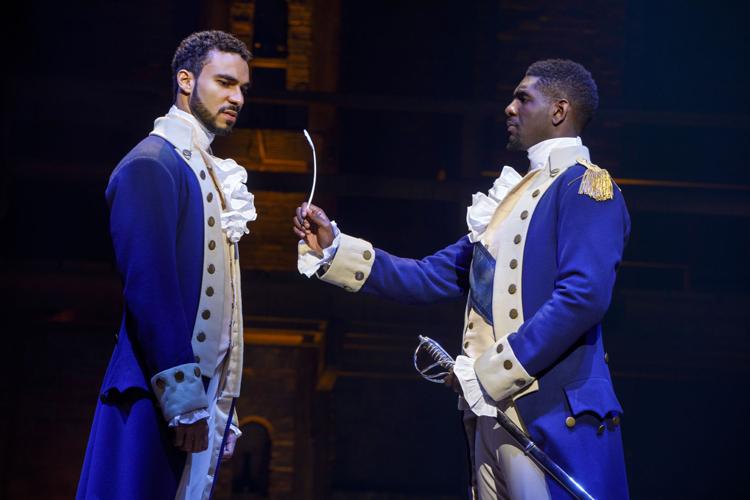
‘Hamilton’ is digital and free!

‘Hamilton’ is digital and free for classrooms during COVID-19

EduHam is the online companion to the Broadway hit

Getting a ticket to see “Hamilton” was a stroke of good luck even before the COVID-19 virus forced Broadway to go dark. The desperate music theatre fan nearly bartered their first born or came close to selling plasma, or skipping rent, for a single chance to acquire a pair of tickets to see “Hamilton” creator Lin-Manuel’s history chronicle set to hip song and dance.

A mezzanine seat was acceptable. Front row or orchestra? Forget about. The “die hard” enthusiast would settle for a standing-room only aisle slot after waiting in line in the rain at the Time Square ticket booth. “Hamilton” is hot for audiences young and old. The intended point has been driven home.

Now, a popular learning companion is available to the stage show through a digital, in-school program known as EduHam. It is being made available through August, free of charge, to teachers, parents and students from coast to coast who are held captive in virtual classrooms.

What they will be viewing is not the film version of the megahit Broadway musical on stage at the Richard Rogers Theatre in New York or on tour, that version is scheduled for release in October 2021. But now, a brand new audience has a ticket and can proclaim that “Hamilton” is in the house. Their house.

The launch of EduHam at Home was announced Tuesday, April 21 by “Hamilton” creator Lin-Manuel Miranda and his partners in the venture: producer Jeffrey Seller, the Rockefeller Foundation and the Gilder Lehrman Institute of American History, which developed the curriculum. The program uses a love of the musical to spark students’ interests in creative pursuits and tie them to historical research.

EduHam was born as an offshoot of “Hamilton” itself, and Miranda says the project — in which 250,000 students nationwide have participated — has proved to be a hit as much with cast members as younger people.

“It quickly became our favorite thing we do as a company,” Miranda said in a telephone interview. “I am so inspired seeing what these kids draw on and are able to create.”

The digital version, available for download at gilderlehrman.org/eduhamhome, has been in development for a while. The launch was moved up as Miranda and others recognized a need for kids to have educational projects at home during the coronavirus-induced shutdown of classrooms.

“As a parent, I’ve been so grateful for the curriculum that has popped up online,” the actor-composer said, adding that he’s been a de facto “kindergarten teacher” for his own children: Sebastian, 5 and Francisco, 2. Other Broadway hits are unveiling home online versions of their school-based curriculum now, too: Disney Theatrical Productions, for instance, has just released “The Lion King Experience” (LionKingExperience.com), which trains students in the process of staging their own versions of the musical.

In its original form, EduHam was designed for Title 1 schools — that is, schools in low-income areas receiving federal aid — to bolster the teaching of history.

“Hamilton” has, up to now, offered it in cities in which the musical is performing, whether on Broadway or in Chicago or on tour. It asks students to research figures and events from American history and, as in Miranda’s work, compose songs, poems, scenes or hip-hop numbers based on what they’ve learned. In the live version, students performed their work at the end of the unit; in the digital version, students will submit their work online. Cast members will choose the 10 best every week, to be featured on the website and shared through social media.

“This whole thing is in the DNA of ‘Hamilton,’ ” said James G. Basker, professor of literary history at Barnard College and president of the Gilder Lehrman Institute.

With the encouragement, too, of historian Ron Chernow, who wrote the biography of Alexander Hamilton that Miranda used as his source, Gilder Lehrman adapted the EduHam program for the online version. It was then tested with students in a pilot program involving 70 schools in 37 states.

The instructional aspect of the program, Basker said, is to familiarize students with using primary source material. On the website, he explained, users will find an instructional video by Miranda and 40 characters from the Revolutionary period: some of them figures in “Hamilton,” and others, such as Dolley Madison, wife of the nation’s fourth president, James Madison. Fourteen historical events — for example, the Boston Massacre — are detailed, and a trove of original documents from the period will be available.

It’s the students’ job to pick from among the references as an inspiration for their song, spoken-word piece, or rap number. Basker framed the experience in Miranda terms: “He was looking at the Founders, getting at their ideas, and putting them in the idiom of now.”

“I think it could be the best way to save some parents,” said Seller, “Hamilton’s” lead producer, who was also one of the producers of “Rent.” “This is a great opportunity for kids and their parents to work together and use ‘Hamilton’ in an educational manner in a way to be both entertaining and super-instructive.”

The program has the additional advantages of keeping “Hamilton” current, and forging a connection to the musical in parts of the country that it has not been able to reach in person. The show itself, which employs 450 people in its six companies, is temporarily sidelined, as are some of Miranda’s other projects.

He said he was two weeks into directing a Netflix film version of “Rent” creator Jonathan Larson’s musical “Tick . . . Tick . . . Boom!” when the virus forced production to shut down. As a result, Miranda’s directorial debut is on hiatus, too.

“It’s a time to cope, for the most part,” he said of the suspension of normal life. “That’s not, though, not to mourn the alternate timeline.”

In this timeline, the hope is that a groundbreaking musical can continue to play a leading role in sparking young imaginations.

Managing Editor

Penny Dickerson is a journalist joining The Miami Times following an Africa sojourn and 10-year freelance career in newspaper and magazine. She earned her Master of Fine Arts in creative writing from Lesley University, and Bachelor of Arts in Journalism from Temple University.

Leave a comment

POISED TO ‘SOAR’

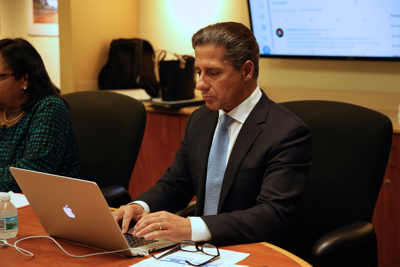
Superintendent Alberto M. Carvalho virtually leads Miami-Dade County Public Schools during COVID-19 pandemic

Penny Dickerson, managing editor

 Updated 
Superintendent Alberto M. Carvalho
“This pandemic has not shutdown the school system. We continue to make strides and have provided more than 1.6 million meals. M-DCPS has distributed more than 112,000 digital devices to students, including laptops, tablets and phones with Wi-Fi connectivity.”

—Alberto M. Carvalho

The Miami Dade County Public Schools boasts a lexicon of numeric pride that affords Superintendent Alberto M. Carvalho every bodacious right to brag. In a time-honored refrain, M-DCPS is the nation’s fourth largest school district with a roll call that includes 392 schools, 345,000 students and over 40,000 employees that exist as its own cultural mosaic. Of the 56 languages spoken, English, Spanish and Creole are primary.

But applause of the hour belongs to the district’s senior class. U.S. News & World Report Best High School rankings 2020 reports, Miami-Dade County Public Schools (M-DCPS) led Florida with 133 schools on the list, including four high schools among the top 100 in the nation. Miami has nine schools in the state’s top 20, and School for Advanced Studies (SAS is the number one school in Florida, and the fourth top school in the nation.

This collective is more than just a montage of math, it is the foundation that has sustained M-DCPS through the unforeseen COVID-19 crisis that abruptly ended a traditional school year. Academic classrooms morphed into virtual learning environments. Dry erase boards became wide screens for Zoom conferences and lunch was distributed city wide. On April 6, the district implemented the Instructional Continuity Plan (ICP) 2.0, and on April 18, Gov. Ron DeSantis announced all Florida schools would continue virtual learning for the remainder of school year.

In an exclusive interview with The Miami Times, Carvalho revealed the district’s progress and innovative plans for a new initiative called SOAR an acronym for securing opportunities for academic recovery. But projected budget cuts of 15 to 25 percent for the district pose a threat to such plans going into the next school year..

Virtual leadership

Carvalho is charged with upholding a standard of achievement set forth by the nine member School Board of Miami Dade County who appointed him in 2008. The former “Superintendent of the year,” was once recognized as one of “The Fantastic Five” educators making a difference in America. He is gracious, and a leader built for the task.

“For the past 25 days, I’ve been in the office alone, but I choose to be here,” Carvalho told The Miami Times April 20. “All my tools are here, two to three screens, access to union groups, and on food distribution days, I put on my mask and hit the streets.”

Carvalho can be seen “hands-on” in Liberty City or North Miami Beach to assist the district’s effort to reduce food insecurities across communities. More than 1.6 million meals have been delivered in Miami-Dade County over the past four weeks including hot meals cooked by local restaurants like Jackson Soul Food in Overtown.

“This pandemic has not shutdown the school system. We continue to make strides,” said Carvalho. “In addition to providing meals, M-DCPS has distributed more than 112,000 digital devices to students, including laptops, tablets and phones with Wi-Fi connectivity.”

Carvalho refers to his teachers as “intimate partners in this virtual endeavor” and says they have participated in professional development workshops to help avoid disruption.

“Our teachers are our first responders who rise to the occasion during crisis,” said Carvalho who engages them daily with “messages from the heart.”

“I am proud of my team and that 99 percent of students have logged on to the M-DCPS portal to have their attendance captured,” said Carvalho. “We have experienced daily attendance rates that average more than 91 percent and the majority of our schools have a daily attendance rate that averages 80 percent.”

Letters of funding appeal

Carvalho has twice during the pandemic used the power of his signature to appeal for funding on behalf of his district. On April 28, he united with the Council of the Great City Schools, the nation’s primary coalition of large urban public-school districts who sent a letter to congressional leaders. It was signed by superintendents of 62 major school districts, including M-DCPS.

The education contingency urged approval of new funding for local school systems in the next coronavirus supplemental appropriations bill and called for additional federal allocation of $175 billion in Educational Stabilization Funds to be distributed at the local level through Title I. The group also urged Congress to provide an additional $13 billion for the Individuals with Disabilities Education Act (IDEA), $12 billion in additional Title I program funding, and $2 billion for E-Rate and emergency infrastructure funds that include public schools.

In a separate letter provided to The Miami Times by M-DCPS, Carvalho sent an address to DeSantis and appealed the imminent distribution of the initial $173M allocated to Florida through the Governors’ Emergency Education Relief Fund included in the Coronavirus Aid, Relief, and Economic Stimulus (CARES) Act. The superintendent recommended the following two-step process:

Sixty percent of the K-12 share of the funds should be distributed based on unweighted FTE to ensure every district receives their fair portion of the majority of the allocation. These funds will be able to cover some costs associated with our rapid conversion to distance learning such as device purchases, internet access for students, and feeding of our communities.

Forty percent of the K-12 share of the funds should be distributed based on each county’s share of the total COVID-19 cases in Florida. This will ensure that schools in areas hardest hit by the virus will be able to cover some of the extra costs incurred by being in the “eye of the storm.”

SOAR – new initiative for M-DCPS

The district is in the early phases of implementing SOAR to not only ensure virtual learning success but bridge the learning gap toward the next school year.

“Our focus will be strategic and in-depth to help identify the most academically-challenged students who further suffer socioeconomic circumstances,” said Carvalho who described the plan in four, infancy phases:

•Students who stand to lose the most will be given maximum attention via virtual learning, support to access ZOOM video conferencing for not just themselves, but parents or caretakers. Addressing a household’s internet capabilities including technical support is important.

•The district is planning expansive summer programs that will continue to provide hot meals and arts and culture exposure including music programs. Field trips and transportation will be provided contingent upon funding.

•Develop and facilitate face-to-face “small group” learning initiatives to better address diverse learning styles, assessment measures and academic needs for a more personalized approach.

•Implement adaptive messaging initiatives that will offer students in need direct access to a virtual academic tutor to maximize academic success.

Carvalho said the district is also considering implementing an “Early Virtual” school year for select students to attend. It would commence prior to the academic year in 2020-21.

Low-income students and summer slide

While Carvalho fully supports the governor’s decision to close schools for the remainder of the academic year, he is abundantly aware that the most challenging academic gap for many students happens over the summer.

“We have what is known as the summer slide. Every summer there is a regression for students who cannot access camps or the arts,” said Carvalho who noted that the season called summer doesn’t care if you are rich. “I expect that his coming summer, we will see an unprecedented gap in program availability despite the best of intent.”

According to Dr. Steve Gallon, III, one of two Black members and vice chair of the M-DCPS school board, when things are bad for everyone, things are critically worse for children and families living in poverty. This harsh reality requires that the district implement a plan of action (like SOAR) inclusive of targeted instruction, resource provision and support to address it.

“As a former teacher, principal, and superintendent, I have spoken with Mr. Carvalho about not only the current plan and process of implementing distance learning, but the harsh reality of the notorious “summer learning slide” and an exacerbated learning and achievement gap among our most fragile and vulnerable student populations,” said Gallon.

“We are looking forward to measures that extend learning through the summer and provide additional interventions and support to students in underserved communities and historically under-performing schools.”

Dr. Dorothy Bendross-Mindingall concurs with her colleague and is an advocate for student mental health services during distance learning.

“From the start of school closures, the superintendent has been very intentional about ensuring that staff is looking at the connectivity and engagement of our most fragile students – those that are disabled, English language Learners, and economically disadvantaged,” said Bendross-Mindingall. “Working through our regions, Title 1 personnel and school police, house visits are being made to mitigate learning losses during school closures. These measures optimize ongoing student success.

 
Managing Editor
Penny Dickerson is a journalist joining The Miami Times following an Africa sojourn and 10-year freelance career in newspaper and magazine. She earned her Master of Fine Arts in creative writing from Lesley University, and Bachelor of Arts in Journalism from Temple University.
Leave a comment

Penny Dickerson awarded GSA Fellowship 2017

For Immediate Release
November 11, 2016
Contact: Todd Kluss
tkluss@geron.org
(202) 587-2839
America’s Top Reporters on Aging Chosen for Fellowship ProgramThe Gerontological Society of America (GSA) and New America Media (NAM) have selected 16 distinguished reporters for the next cohort of the Journalists in Aging Fellows Program, now in its seventh year. They represent a wide range of general audience, ethnic, and senior media outlets, including several public radio affiliates, daily newspapers, and national publications.

The fellows will convene during GSA’s Annual Scientific Meeting — scheduled for November 16 to 20 in New Orleans, Louisiana — and utilize the more than 450 presentation sessions and 4,000 expert attendees to develop a major aging-focused story or series. These proposed projects, to be published in 2017, will span such concerns as elder isolation, homeless seniors, the digital future, and aging in ethnic populations.

“The GSA meeting presents a comprehensive look at aging, and our new fellows will serve a vital role by cultivating public awareness of what it means to age in America,” said Karen Tracy, GSA’s Senior Director of Strategic Alliances and Communications. “We provide a unique venue to help them understand everything from the latest discoveries in the health sciences to the impact of the 2016 elections on older adults.”

The fellows program is supported by funding from The Silver Century Foundation, AARP, The Commonwealth Fund, The Retirement Research Foundation, and The John A. Hartford Foundation.

“Our fellowship collaboration with GSA has been essential for educating reporters and the increasingly diverse communities they inform about the challenges of growing older.” said NAM Executive Director Sandy Close. “The wide range of topics this year and the depth of the proposals shows that journalists are grasping the impact of these issues in every community.”

In New Orleans, the fellows also will report on new developments in aging and participate in a day-long workshop, where experts will discuss the latest research and provide insight on key issues facing Americans as they age. Continuing fellowship grants also are being provided to allow nine previous fellows to participate in the meeting. A continuously updated list of stories generated by the program’s more than 100 alumni is available at www.geron.org/journalistfellows.

The program is co-directed by Todd Kluss, MA, GSA’s senior manager of communications, and Paul Kleyman, senior editor of NAM’s ethnic elders newsbeat. Kleyman also is the founder and national coordinator of the Journalists Network on Generations, which includes more than 1,000 writers on aging.

The new fellows:

Francisco Castro (La Opinión)
Project: Varied series on the daily struggles of food and rent for older Latinos, elder abuse among Latinos in home care facilities, and “old love.”

Lois M. Collins (Deseret News, Salt Lake City)
Project: Redefining “community” in old age.

Alice Daniel (KQED Public Radio’s “California Report,” San Francisco)
Project: Mental illness in older Hmong and Lao refugees.

Merdis “Penny” Dickerson (Florida Courier/Daytona Times)
Project: Hunger among older African Americans.

Neil Gonzales (Philippine News)
Project: Barriers to and opportunities for healthy aging, particularly within the Filipino and Asian American community.

Leoneda Inge (North Carolina Public Radio – WUNC)
Project: The “reverse migration” of black retirees to North Carolina.

Erica Manfred (SeniorPlanet.org)
Project: Accessible hearing-loss technology.

Deborah Martinez (KSFR-FM, Santa Fe, New Mexico)
Project: Varied series on navigating Social Security and Medicare, the challenges and opportunities facing New Mexico’s retirees, and recent lawsuits brought against two Santa Fe elder care facilities.

Sister Charlene Muhammad (Los Angeles Sentinel/L.A. Watts Times Weekender)
Project: Intersection of homelessness, dementia, and substance abuse.

Elizabeth Payne (Ottawa Citizen)
Project: A series of articles related to falls, including prevention, causes, costs, and consequences.

Katy Read (Star Tribune, Minneapolis)
Project: Individual and community initiatives to address the dangers of isolation and loneliness.

Randy Rieland (Smithsonian)
Project: Use of artificial intelligence to combat social isolation.

Michael O. Schroeder (U.S. News & World Report)
Project: Financial exploitation of older adults.

Afi-Odelia E. Scruggs (Alldigitocracy.org)
Project: Ageism in the media and its coverage of older adults from minority communities.

Chandra Thomas Whitfield (NBCBLK/NBCNews.com)
Project: Challenges faced by LGBT older adults of color.

Ke “April” Xu (Sing Tao Daily)
Project: Scams haunting Chinese older adults in the U.S.

###

The Gerontological Society of America (GSA) is the nation’s oldest and largest interdisciplinary organization devoted to research, education, and practice in the field of aging. The principal mission of the Society — and its 5,500+ members — is to advance the study of aging and disseminate information among scientists, decision makers, and the general public. GSA’s structure also includes a policy institute, the National Academy on an Aging Society, and an educational branch, theAssociation for Gerontology in Higher Education.

New America Media (NAM) is the country’s first and largest national collaboration and advocate for over 3,000 ethnic news organizations. Nearly 60 million ethnic adults connect to each other, to home countries, and to America through ethnic media, the fastest growing sector of American journalism. Founded by the nonprofit Pacific News Service in 1996, NAM is headquartered in California with editors in New York and Washington, DC.

Follow GSA on Twitter and Facebook!