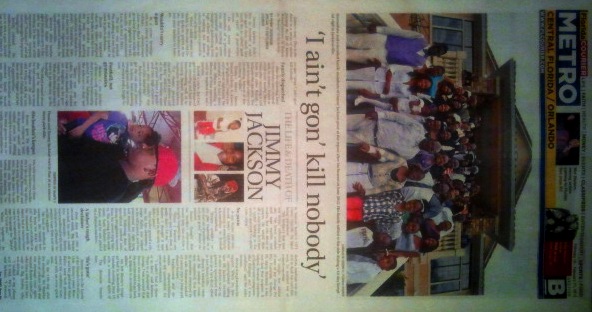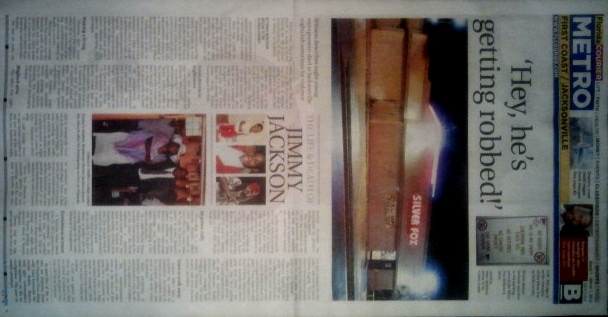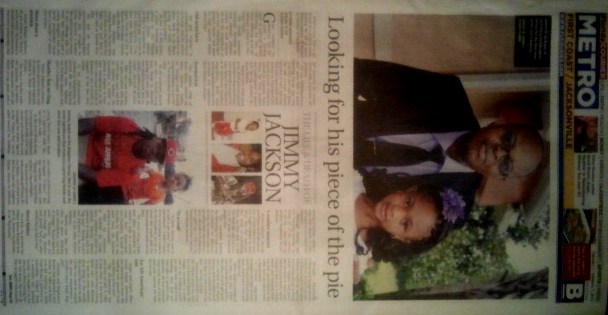
Part II – “The Life & Death of Jimmy Jackson.”

 florida-courier-logo

 SAMSUNG

THE LIFE & DEATH OF JIMMY JACKSON

January 31, 2013

Looking for his piece of the pie

Editor’s note: This is the second in a series of stories framing the life of James Roland Jackson, III, known as “Jimmy” to his family.

BY PENNY DICKERSON
SPECIAL TO THE FLORIDA COURIER

Gun violence in America has become a leading topic of political debate following the Dec. 14 mass shooting at an elementary school in Newtown, Conn.

The deadly massacre prompted President Barack Obama’s administration to craft proposals for the enactment of new laws, including background checks and bans on high-capacity ammunition clips.

Old news here
But gun violence is nothing new on the streets of Florida. And the victims of deadly gun violence are more likely to be Black, young and male, rather than first graders.

In Part I of this series, a crime database maintained by The Florida Times Union indicated that 71 homicides occurred by gun violence in 2012. Fifty-six of the 71 victims were African-Americans. Forty-six of the 56 African-American victims were Black males.

Jimmy Jackson was among them. He was shot four times at the Silver Fox Night Club and died 11 days later at Shands Hospital.

He will be forever mourned by a strong Black father who struggles to move forward; a mother who grieves for her younger son; siblings who lost their best friend; and a young daughter who will never accumulate more than a handful of memories of him.

More than a statistic
James Roland Jackson, III was known as “Jimmy” to his family. He boasted a broad smile and owned an infectious personality that left everyone he encountered with a positive impression.

He was well-mannered and grew into a good-looking young man with a six-feet, one-inch frame. He had enough athletic prowess to earn him football and basketball scholarships to Graceland University, a small, liberal arts school in Lamoni, Iowa.

There, he both roomed and participated in sports with his big brother, Anthony Rozier.
Jimmy came from good stock. Both parents earned bachelor’s degrees in business, from Morehouse College (father) and Florida A & M University (mother), respectively. Both were working professionals who nurtured and supported their children’s dreams.

Normal kid
The middle child of three, Jimmy adored his older brother Anthony.  Younger sister Brandi knighted Jimmy as her hero. The three were inseparable.

By all accounts, Jimmy was just a normal young man living in America, paving his own path. He was multifaceted and comedic, ambitious and talented – but with an entrepreneur’s spirit.

After one year in Iowa, he grew restless with the town’s slow pace and left his brother behind. He transferred to FAMU to pursue a degree in business management at FAMU’s renowned School of Business and Industry in support of his first love: music.

As an undergraduate student in Tallahassee, he owned his own hip-hop clothing store, Tallahassee Hot Boys Apparel, and sold CD mixtapes.

Hustler, but no thug
While Jimmy’s relatively short journey from crib to casket seems tragically typical in Black America, it’s not.

He was a hustler without question. But stereotypes associated with the world of rap music and a young Black man’s death at a nightclub defy Jimmy’s life’s truth.

At the time of his death, he was gainfully employed by a Jacksonville AT&T call center and worked as road manager for artists signed to the “Nappy Boy” music label owned by Tallahassee native producer/singer/rapper “T-Pain.”  Jimmy worked closely with “Young Cash,” one of Nappy Boy’s rap prodigies.

He shared an apartment with a steady girlfriend, Kiera Bailey, and doted over his five-year-old daughter Denia, whom he fathered during a college relationship with Shante C. (Her full name is not used at her request.)

Although Jimmy was not “running women,” he loved all of the women in his life – especially his mother, Stephanye Rozier-Jackson.

A mother mourns
Rozier-Jackson literally meditates on fond memories of her baby boy since his tragic murder in June 2012. She has near-perfect recall of everything from his first step to the last time she saw his face. The 27 years in between plague her.

“The weekend before the shooting, he was here in Orlando for Memorial Day. He visited with his grandmother who had surgery, attended a barbeque, and gave me a ride in his brand new white Camaro,” said Rozier-Jackson.

‘In a rush’
“At birth, Jimmy was in a rush to get here,” she remembered. “I didn’t know if we were going to make it to the hospital, but he entered this world with the most peaceful smile on his face.

“He loved being a baby and often pretended he couldn’t walk so I would carry him,” Rozier-Jackson chuckled. “It took 18 months for Jimmy to eat solid food; his favorite drink was Gatorade.”

After he eventually shelved his imaginary childhood friend he named “Johnny,” Jimmy yearned to hang with the “big boys” during church and followed in the footsteps of his older brother Anthony.

“Jimmy was lazy and slow to move. Anthony was mischievous and full of energy,” Rozier-Jackson said. “Anthony was the take-charge big brother and Jimmy had no other choice but to fall in line.”

Stern father
As a boy, he revered his father, James Roland Jackson, Jr., known by the family as “Big Jimmy.”

All-male Morehouse College and Omega Psi Phi Fraternity instilled an ethical framework in the elder Jackson which he used to encourage Jimmy to avoid social stigmas and gravitate towards a more conventional presence: short-cropped hair cut, a clean shave, and tailored clothing with pants fitted to the waist. Belts for pants were a requirement.

A former corporate manager, the elder Jackson both hired and fired young men–many who were just like his son.

When Jackson speaks of his slain son now, reflective words fall fast and free. His pillar-of-strength guidance molded and shaped Jimmy, and the elder Jackson is not ashamed to admit that he was a stern father – but not a tyrant.

Jackson still resides near the Atlanta home he built for his blended family. He fought furiously to maintain it by working multiple jobs that ranged from banking, shoe and portrait sales to project management. He has endured hard work most of his life and only wanted the best for his son.

An ‘All-American’ son
Anger and regret often trump happy memories, but nothing can erase the abiding love passed from one Jimmy to the next.

“My All-American boy was born on July 2, 1985. It was close to the fourth of July and he had a strong heart rate,” said Jackson. “It was the most tremendous thing in the world. He looked like me, he talked like me, and we shared the same mannerisms. I couldn’t have been happier.”

Jackson and Stephanye Rozier had married a year earlier in 1984 and three-year-old Anthony, a child from Rozier’s previous relationship, helped form a welcome trio. Jackson treated his stepson as his own, but when young Jimmy was born, the new father struggled emotionally to treat both sons equally.

“I loved him so much, but felt inhibited,” said Jackson. “I couldn’t show him (Jimmy) love and didn’t know how to relate to having one son and then another. I also didn’t want Anthony to be jealous of Jimmy.”

Proud dad
The growing pains of being both a newlywed and a new parent created stressors in the marriage. But the elder Jackson still recalls fun-filled days of watching his precocious boys wrestle.

“They were two rough and tough young boys,” said Jackson. “They’d tumble in our two-story Norcross (Ga.) home so hard the roof would sometimes shake. I’d have to go up the stairs with a belt.”

The inquisitive young Jimmy was always big for his age and once won a contest in the first grade for being the biggest child.

“His feet were big, he had a great smile, and everybody liked him,” said Jackson.

Discipline and determination were characteristics Jackson eagerly imparted to prepare all of his children for a better-than-average chance to succeed.

Family transition
In 1990, the couple welcomed the birth of daughter Brandi. But post-partum depression and career changes seemed to cause constant turmoil.

In 1991, the siblings and their mother moved back to Orlando. Following the loss of their home, the four returned and the entire family lived in an Atlanta-area apartment for a short period. Over time, the relationship was irreconcilably broken.

A 1981 love affair that began in Tallahassee ended in Atlanta in 1994; all three siblings and their mother returned to Orlando.

The formative years
The untimely divorce of his parents served as an indelible marker, and Jimmy’s formative years were painfully divided between two households – his father’s home in Atlanta and an eventual return to Orlando to live with his more lenient mother.

Jimmy was eight years old when he returned to Atlanta to live with his father.

“I was presented the perfect opportunity to do everything I wanted to with Jimmy,” said Jackson. “When he came to live with me, we traveled all across the country to football games and other stuff. He adjusted to attending a new school and making friends.”

In the sixth grade, Jimmy made the basketball team as a point guard and continued playing through his tenure at Atlanta’s Evans High School.

“My son loved basketball and Allen Iverson, but he didn’t have Iverson talent,” said Jackson.“  He was a physical specimen. I wanted him to be a football punter because he had huge legs, but he wanted basketball,” Jackson remembers.

Father-son conflict
Young Jimmy’s love for shooting hoops also came with a desire to emulate his NBA idols. He began to explore urban fashion fads. Conflict between father and son ensued.

“Jimmy wanted to grow braids, and I was just vehemently against that,” Jackson added. “His school life was central to me. I always visited their schools and was proud about how he was received as a student and a good kid. I didn’t want his image to be tarnished because I know how the world views Black men.”

Jackson enjoyed watching his son learn to drive, and typical father-son time.

“Jimmy did great impressions of characters from the animated show ‘South Park.’ I loved that,” Jackson laughed. “He also loved to scare other people and pull pranks, but he was the scariest one of all.”

Time to leave
Family, religion, and tradition were all integral to Jackson in his youth in Georgia and in Florida. He was nurtured by an extended family that included relatives with music performance careers, mentoring uncles and godsisters. And though Jimmy liked Atlanta, he longed to be with his mother and siblings in Orlando.

“I really had no answer for that void, because he could move around unchecked with them and away from me,” Jackson stated. “That was more important to him than anything. He could grow his braids and be free to do as he pleased, and that was OK. He stopped being ‘my Lil ‘Jimmy’ and was gone.”

Unresolved issues
When he turned 16, Jimmy left his father’s close supervision and returned to Orlando.

It was a painful exit, especially since Jimmy was murdered before he could fully reconcile his relationship with his father.

As he got older, Jimmy defied his father’s conventions with his own sense of style including multiple tattoos, shoulder-length dreadlocks, clothing that gave him pop culture swag and an individuality he turned into an enterprising venture called “Exclusively J.”

Jimmy’s business goal: to manage artists’ careers and to “brand” himself as has Puff Daddy/P.Diddy.

The two spent Christmas together in 2005 and the elder Jackson made a few visits to Tallahassee when his son attended FAMU. Their personal contact during Jimmy’s early twenties was so minimal that the elder Jackson didn’t even know he was a grandfather.

Jackson met his granddaughter Denia for the first time at his son’s funeral.

Still, by all accounts, the younger Jackson was a family success story. His kinfolk were starstruck when their beloved Jimmy invited them backstage during a concert to meet R&B star Chris Brown.

A final conversation
Jimmy’s parents remain proud of the impact their son had on the world in the short 26 years of his life, from his first baby step to his final breath. They each long for one more chance to communicate their love.

“During his last days on this earth, I saw my son more than ever because he was often traveling to Tampa and Miami promoting artists,” offered Rozier-Jackson.

“If I were given an opportunity to have a final conversation with my son, I would hold his hand, let him know that I love him, I’m proud of him, that I would lay down my life for him, and reassure him that God loves him,” she added.

A heavy load
James Jackson’s grief weighs heavily on him. His love for his son was often difficult for him to fully express. Even in retrospect, he remains direct and brief.

“I would tell him how much I wish he could have been with me every day, like during the middle school years,” mused the elder Jackson.

“I am committed to achieving justice for Jimmy, but not nearly as committed as I would like to be. It is absolutely a daily process to keep things moving.”

The death of Jimmy Jackson remains unsolved. Homicide detectives suspect the motive was armed robbery, but few leads have surfaced. To date, the case is cold.

Part 3: Jimmy’s family endures an 11-day bedside vigil at Shands Hospital and a subsequent funeral and burial without financial support.

Jimmy Jackson July 2, 1985 – June 13, 2012James Jimmy Jackson, III Headshot (1)

candle in hands

Leave a comment

Part III – The Life & Death of Jimmy Jackson

‘I ain’t gon’ kill nobody’

SAMSUNG

Immediate and extended family members of Jimmy Jackson pose at the repast after his funeral in June 2012. His family rallied to his side during a 10-day hospital vigil in Jacksonville. (CHARLES W. CHERRY II / FLORIDA COURIER)

Editor’s note:  This is the third in a series of stories framing the life of James Roland Jackson, III, known as “Jimmy” to his family.

BY PENNY DICKERSON SPECIAL TO THE FLORIDA COURIER

Jimmy Jackson didn’t live to become a middle-aged man, much less reach the so-called “golden years” of post-retirement.

He will never relive memories of a prosperous and exciting entrepreneurial career, of his daughter graduating from high school and college, of walking her down a church aisle as a proud father of the bride.

When asked where her daddy is, five-year-old Denia Jackson points to the sky. She now believes bullets send daddies to heaven.

Wouldn’t carry a gun

In a crime investigators are calling a random robbery, eyewitnesses claim two Black males approached Jimmy at the Silver Fox nightclub in Jacksonville at approximately 4 a.m. on June 2, 2012.

The club was packed. The parking lot was full of cars that were parked in rows in pitch darkness.

Jimmy was unarmed when the killers pumped four bullets into his 6-foot, 1-inch muscular frame. His body was gushing blood until first responders rushed him to Shands Hospital’s TraumaOne. Eleven days later, he was dead. The crime, originally listed as aggravated battery, became a homicide.

Jimmy’s older brother Anthony Rozier encouraged Jimmy to carry a firearm for protection while working for his own artist representation company called “Exclusive J” and as road manager for rap artist Young Cash.

Jimmy refused.  He made a conscious decision not to own a gun. According to Rozier, Jimmy’s response was, “I don’t need no gun ‘cause I ain’t gon’ kill nobody.”

Family dispatched

After the shooting, family members were immediately in contact. Rozier arrived from nearby Mount Dora after receiving a call from his sister Brandi, a Jacksonville resident. The pair informed others with promising reports of Jimmy being “stable.”

Jimmy’s father, James Roland Jackson, Jr., known as “Big Jimmy,” lived a parent’s worst nightmare. He endured a five-hour drive from Atlanta recalling a lifetime of fond memories until he reached his son’s bedside.

Jimmy’s uncle, Jay Carr, got his call within hours of the shooting and had the heartbreaking task of informing Jimmy’s mother, Stephanye Rozier-Jackson.

“I’d always prepared myself to get a phone call like this,“ said Carr.  “Three of my four brothers were in prison before I graduated from high school because they couldn’t stay out of the street life.”

But he never expected to get the call about Jimmy, an honest, hard-working young man with no criminal record and a bright future.

Football, not gymnastics

Shante C., the mother of Jimmy’s only child from their previous relationship arrived from Tallahassee. She reflected on their last conversation.

“Jimmy was one for jokes. So when I shared that I was headed to sign our daughter up for gymnastics, his response was ‘What, you mean you don’t want to go sign her up for football?’

“We joked around about that, and he mentioned he had something to send his daughter. He continued trying to talk me into moving to Orlando where there were bigger and better opportunities.”

Jimmy’s immediate and extended family would now unite for a 10-day bedside vigil.

His brother’s keeper

Jimmy gave his older brother Anthony a ‘middle-fingered salute’ and smiled when his sibling entered his hospital room. The lewd gesture was comedic communication between the two half-brothers, who were very close.

Anthony Rozier was Jimmy’s “go-to guy” for advice on personal, financial, and even some business decision. The last time he saw Jimmy was three weeks before the shooting. Despite owning a brand new Camaro, Jimmy wanted to borrow Rozier’s 1971 Chevy Chevelle. He liked being ‘old-school.’

“My brother’s first love was music,” reflected Rozier. “He loved animals and kept reptiles and snakes, but was afraid of spiders. He would slide off a roof before he’d face a spider! Nothing in the world mattered if a spider came along.”

No panic

It was Rozier who convinced Iowa’s Graceland University to award Jimmy scholarships in football and basketball.

“Jimmy couldn’t really play basketball as a kid, but out of nowhere he just got good,” Rozier explained.

Rozier thought that his brother’s athleticism would help him endure a lengthy hospital stay.

“When I learned my brother had been shot, it really didn’t hit me,” said Rozier. I thought it was once, and in the arm, so I didn’t panic.”

One bullet grazed a rib, one hit his abdomen, a single bullet was lodged in his left buttock, and one punctured his right lung and remained embedded there.

Following days of specialized medical care, Jimmy struggled to recover from his severe lung injury. His strong body weakened, both kidneys shut down, and he was placed on a dialysis machine.

A father’s tough decisions

Over days and into a second week, Big Jimmy watched his son’s condition deteriorate. Jimmy was transferred to the most critical area of Shands’ Intensive Care Unit and was on life support.

He had no medical insurance. His health benefits from his AT&T “day job” had not yet kicked in. He remained heavily sedated, but at various intervals was able to communicate by recognizing simple sign language for “peace” and “I love you.”

When surgeons informed Big Jimmy that the dialysis machine was unable to flush his son’s kidneys, he reached out to trusted expertise.

“I sought the advice of one of my Omega Psi Phi Fraternity brothers, Dr. Harry Marshall, a former Iraq War surgeon. It helped, because surgeons at Shands were using complex dialogue and I was conflicted,” said the elder Jackson.

Jimmy was placed on life support. When the family contemplated taking him off, Jackson decided to allow doctors to try aggressive specialized treatment as a last-ditch effort to save Jimmy’s life.

Jimmy’s baseline vitals and his medical condition improved, but family members remained by his side. Rotations included round trips to local and distant homes.

Employment and domestic responsibilities were left unattended. Expenses mounted.

“I hadn’t had a shower in days,” said Jackson. “Prior to a (hospital) shift change, I was assured that Jimmy was once again stable and decided to go back to Atlanta to reconcile my affairs.”

He left Jimmy’s hospital bed in Jacksonville on Tuesday morning, June 13 with a renewed spirit of hope.

The decision haunts him.

‘He’s gone’ 

Jimmy was in the hands of the Shands Critical Care Unit.  Jimmy’s sister Brandi and his girlfriend Kiara Bailey were both present when his condition worsened with an eerie quickness.

On the 11th day after the shooting, the familiar chain of cellular calls and text message once again ensued. Rozier called Carr, who then sent a text message to Big Jimmy, who was driving.

“I looked at my phone and it read, ‘He’s gone,’” said Jackson. “I immediately turned around and drove back.”

“We all thought Jimmy was gonna pull through,” offered Rozier.

No stranger to death

According to her mother, Jimmy’s daughter Denia had already been exposed to several deaths at the young age of four.

“My grandfather passed away the same night Jimmy was shot,” Shante C. explained. “My daughter is a very smart and bright child. Anybody who knows her can tell you she has the soul of someone who has been here before and I didn’t really feel I needed to wait and tell her.

“So I told her the evening I found out. She sat there blank for a few minutes as if she was processing what I told her, and then she broke down in tears and repeated over and over again, “I want my daddy!”

Rozier remained his brother’s keeper until the end.

“The last thing I said to Jimmy was, “They gon’ have to cut your dreadlocks off for surgery.” He looked at me funny and I said, ‘Just kidding.’”

Rozier now had a responsibility he never imagined or wanted – getting things together in preparation for his baby brother’s funeral.

Orlando homegoing

For an already emotionally stressed family, the subsequent funeral exasperated them from planning to payment.

Postell’s Mortuary in Apopka was selected. A glitch elevated their grief when the family was informed two days before the Saturday morning service that Jimmy’s life insurance from his AT&T job could not be used for payment. Rozier had less than 48 hours to come up with $10,000 to pay for his brother’s funeral.

“I called any and everybody,” said Rozier. “My grandmother, Mae Smith, gave $2,500 and I got $500 each from several different family members. Rap artist T-Pain also helped. I scrambled and came up with the money in one day.”

Carr, a property supervisor who works for the city of Orlando, was willing to borrow from his pension to bury the nephew he remembers as a gentle and soft giant.

“Everyone was willing to help, but we were restricted by time,” said Carr. The family has applied for bereavement reimbursement from the state attorney’s office in Jacksonville and social service agencies. More than six months later, they haven’t received anything as of this writing.

No arms

Jimmy Jackson’s body arrived at Postell’s Mortuary without his arms. He was a bone donor. Both limbs had been sawed off to preserve his bone marrow, which can save the lives of people with diseases like leukemia and breast and ovarian cancer.

Jimmy’s decision to not carry a gun was as principled as his choice to leave behind two strong limbs to save a stranger’s life. A warm humanitarian until his untimely end, it was perhaps his most valiant contribution to society.

The crime against Jimmy Jackson – and his family – remains an unsolved cold case.

Part 4: The Silver Fox nightclub and its violent history.

1 Comment

Part IV – “The Life & Death of Jimmy Jackson.”

florida-courier-logo

SAMSUNG

“Hey, he’s getting robbed!”

Witness describes night young entrepreneur died at Jacksonville nightclub notorious for violence

February 28, 2013Filed under METRO Posted by
Click link below to read Florida Courier digital archive


Witness describes night young entrepreneur died at Jacksonville nightclub notorious for violence

Editor’s Note:  This is the fourth in series of stories framing the life of James Roland Jackson, III, known as “Jimmy” to his family.

BY PENNY DICKERSON SPECIAL TO THE FLORIDA COURIER

Adult entertainment and nighttime nudity continue to thrive despite a nationwide recession.

More than 15,000 employees rely on the industry for their livelihood, including strippers who balance their weight on five- to eight-inch heels while performing tricks on a pole. Male audiences are left mesmerized.

Despite protests and legislative attempts by evangelicals and conservative groups like NIMBY (Not In My Backyard) to bar their existence, adult entertainment remains the object of a man’s loose dollar bills and profitable subjects for a business estimated to gross more than $7 billion through the year 2017.

Companies in this industry operate adult entertainment venues in which striptease or other erotic or exotic dance is regularly performed for males, females or mixed audiences. Upscale establishments referred to as Gentlemen’s Clubs are distinct among businessmen and professional athletes and offer patrons appealing V.I.P. privileges.

Making a living

However, their urban counterparts like Jacksonville’s Silver Fox nightclub have the reputation of being establishments that can permeate violence as deadly as murder.

Shootings have become Silver Fox staples and the homicide death of Jimmy Jackson last year has reinforced the club’s status as a business that compromises the intent of patrons who seek mere satisfaction.

He was 26 years old when he was shot four times at the Silver Fox on June 2, 2012 at approximately 4 a.m. He died 10 days later at Shands Hospital Jacksonville.

Jackson was not at the club to illicit strippers nor was he believed to be drunk the evening he became another shooting victim at the Silver Fox.

He was content in his role for the evening – serving as road manager for Young Cash, a local artist signed to Tallahassee-based rap artist T-Pain. Both are a prodigy of the iconic South Florida-based rapper Flo Rida.

From dream to nightmare

Cash and his entourage rented the club for his birthday “after party.”

According to his friend and eyewitness Rodney Lamont English, a.k.a. Wood, “Jimmy arrived earlier in the evening to help set up and his white Camaro was later brought and parked by a friend. He was not from Jacksonville or familiar with the Silver Fox.”

An entrepreneur at heart, Jimmy established his own venture – Exclusive J – in hopes of becoming an independent music mogul who managed the careers of emerging artists. This was his dream.

A fascination for stardom attracted a mixed-gender crowd that surpassed capacity. The overflow parking area is an unlit backdrop for potential crime and in this patch of crumbled asphalt and grass, two Black males robbed Jimmy Jackson at gunpoint. Four bullets took him down.

The incident helps quantify the establishment’s growing reputation for criminal activity, including five incidents that involved discharging a firearm.

Blighted area

The Silver Fox nightclub is strategically located in the ruins of Jacksonville’s industrial blight. An area bustling with traffic and activity by day transforms into a desolate area of abandonment at night leaving few to notice activity – criminal or otherwise.

A cold storage freezer and farmer’s market sit east and west of the club. Both are flanked for miles by mechanic and scrap metal shops. Rows of fleet trucks and used tire garages are in comfortable proximity to a popular fried chicken franchise and the random presence of seafood shacks leave Florida’s southern air with a caustic stench.

Silver Fox clientele repeatedly ignore the surroundings, and for more than a decade, the windowless structure has maintained its pleasure-seeking appeal.

The club conforms with a 2005 law passed by the city of Jacksonville requiring fully nude establishments to be located in areas zoned heavy industrial.

Further, the law prohibited nude clubs from being within 500 feet of schools and churches and within 1,000 feet of homes. Partial nudity is featured at the Silver Fox.

Popular for stripper activity and parties, the Silver Fox is formally listed as a Bikini Club featuring Black dancers. Patrons are offered day and night covers of $2 and $5, respectively. Dance prices are listed as $10 with drinks for $2.50.

48 police calls

According to a Jacksonville Sheriff’s Office (JSO) public records report (2011-12), more than 48 “Calls for Service” resulted in police dispatch to the nightclub’s associative address on West Beaver Street. Calls range from noise violations, stabbings, and drunken fights. Discharging a firearm leads the list.

In a 2009 Florida Times Union feature titled, “Jacksonville Clubs keep an Eye out for Guns,” the Plush Nightclub, a popular mixed-crowd venue, was cited for 31 firearm incidents within 125 feet of its commercially zoned property. The records were released by JSO and covered a three-year period.

The Silver Foxx was runner up with 12; the gun violence is neither new nor ceasing. What does continue to change for the establishment is management.

Eyewitness account

A Youtube video dated June 21, 2012 promotes a “grand opening” for the Silver Fox, now spelled with a single X.  This celebratory debut and name change came eight days after Jimmy Jackson was declared dead at Shands Hospital.

“Jimmy had the biggest smile on his face and was just enjoying life that night,” reflected his friend, Rodney English. “I’ve witnessed three or four people getting shot there and each time it’s the same club, same spot, no lighting.”

One of a few cooperating witnesses, English further added that two JSO police officers were on either side of the crime scene, but were called to another location shortly before the crime against Jackson took place. “I was close enough to see two Black males in black T-shirts. They put on their seatbelts and drove away slow when I hollered, ‘Hey, he’s getting robbed!’” English added.

“A small handful of people saw the shooter(s),” offered Detective Bobby Bowers, lead homicide investigator charged with bringing justice. “All were heavily drinking. Panic ensued and most ducked or ran,” he added.

Tried to walk away

Jackson didn’t have a proclivity for conflict or contention. According to Bowers, he complied with the random robbery and tried to walk away when he was shot.

More perplexing to Jackson’s grieving family and friends is why the Silver Fox nightclub remains open for business.

The establishment’s owners would not comment at the time of this writing. A telephone request for a comment on Wednesday from a man who stated that he was the owner or manager yielded the following response: “No, we don’t wanna participate.’’

A civil suit against the Silver Fox has been filed on behalf of Jackson’s only surviving daughter, five-year-old Denia Jackson.

In part five of the series, an attorney from the Chestnut Firm along with lead homicide Detective Bobby Bowers will offer commentary.

Leave a comment

Part V – “The Life & Death of Jimmy Jackson.”

florida courier

‘He looked like he had money’

March 7, 2013 Filed under METRO Posted by

 Editor’s Note: This is the fourth                                             in a series of stories framing the                                            life of James Roland Jackson, III,                                      known as “Jimmy” to his family.

BY PENNY DICKERSON
SPECIAL TO THE FLORIDA COURIER

James Jimmy Jackson, III Headshot (1)

Justice is a comfort surviving families rarely experience. And for most, true “closure” never comes.

The elapsed time between a violent crime ending in death and judicial resolution can be long and painful. The investigative process is slow and deliberate. Missteps police make along the way are often mourned as much as the death of the loved one.

This scenario is depicted in the case of Jimmy Jackson whose tragic death is a dual statistic: a violent gun crime in America followed by a cold case investigation.

Jimmy’s life
In previous installments, the 26-year-old entrepreneur’s ambitions were highlighted. The son of James R. Jackson, Jr. and Stephanie Jackson-Rozier, Jackson’s formative years were wrought with emotional discomfort as he adjusted to his parents’ divorce and physical separation from his siblings.

He honed his athleticism as a youth in Atlanta while living with his father and earned a high school diploma in Apopka – his mother’s hometown. Jackson briefly attended Graceland University in Iowa on a sports scholarship then transferred to Florida A&M University, where he majored in business.

In addition to his artist management venture called “Exclusive J,” Jackson was employed by an AT&T call center in Jacksonville. Above all, he was a young father who doted over his five-year-old daughter Denia. She is his sole surviving dependent.

The murder
While working part time for rap artist “Young Cash,” a prodigy of the rapper Flo Rida, two men robbed him at gunpoint at the Silver Fox nightclub.  Four bullets were pumped into Jackson’s 6-foot, 1-inch athletic physique. His family endured a 10-day vigil at Shands Hospital Jacksonville before Jackson was pronounced dead there on June 21, 2012.

Police are calling the tragedy a random robbery.  Jackson’s murder remains unsolved.

Organized groups
Detective Bobbie Bowers is a 17-year veteran of the Jacksonville Sheriff’s Office (JSO). He has investigated hundreds of murders. Some result in cold cases; others are solved.

“Jackson’s injuries didn’t appear life-threatening,” offered Bowers.

“The robbery and shooting made the charge aggravated battery, and his subsequent death made it a homicide.”

According to Bowers, Jackson was random prey for a sweep of growing street crimes.

“These people are organized. They watch church parking lots and places where women leave purses in cars then break-in or rob them,” Bowers explained.

“Jimmy drove a nice car and looked like he had money, so he was a target much like members of the Jacksonville Jaguars NFL team. They (pro football players) are known to travel to clubs with other players and are believed to have a ‘pocketful of money.’ ”

Nobody has come forward
By August 2012, Bowers still had no leads in the then two-months-old case.

“Nobody has come forward,” Bowers lamented. “Radio stations put it on the air immediately following the shooting, but there is a very slim chance the case will ever be solved.”

Jackson’s wallet taken during the robbery has been retrieved and remains in police custody. Fingerprints couldn’t be lifted.

“I’ve made calls and we have composite drawings. What we really need is for people to cooperate,” Bowers pleaded.

The detective attests that Jackson was “looking out for Young Cash” when he was victimized.

“Witnesses report that Cash had too much to drink and was outside throwing up,” said Bowers. “Jimmy went out looking for Cash and then went to get something from his white Camaro.”

The crime took place at 4 a.m. It was pitch-dark in the Silver Fox parking lot when two Black males wearing dark clothing pulled guns and robbed Jackson. Jackson complied, but was shot while walking away.

chestnut

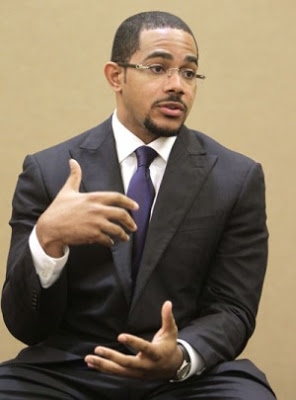
Attorney Christopher Chestnut has been retained to represent Jimmy Jackson’s family.

Investigation frustrates father
James Roland Jackson, Jr. likens his son’s investigation to a second death.

The senior Jackson has returned to his slain son’s crime scene three times since the murder took place. Like many survivors, he thinks he can do a better job than investigators, but doesn’t want to supersede their professional efforts.

“I am still losing sleep,” confessed Jackson. “I don’t feel their efforts (JSO) are guided and they are not supportive of me getting involved.”

He has not spoken to Detective Bowers in close to a month.

“My frustration is that there is no flow of communication, and I am not satisfied with any of it at this point,” stated Jackson. “This thing has become so commonplace that people are becoming desensitized towards the plight of homicide victims,” he added.

Community outreach
“Crime doesn’t pay, but we do!”  
This First Coast Crime Stoppers tag is intended to persuade witnesses to come forward. The non-profit organization and global movement offers monetary awards up to $1,000 for anonymous tips.

None have come forward for Jackson in the eight months since he was killed. Money was the crime’s motive, but cash – at least not $1,000 – isn’t an incentive to dig up leads for justice in Jimmy’s case to date.

While investigators have encouraged Jackson to “let them do their job,’’ the dad has reached out to former Jacksonville Sheriff Nat Glover, current president of HBCU Edward Waters College and his son’s congresswoman, Corrine Brown, for help.

Glover referred the elder Jackson to JSO’s chief of staff. Brown’s office has been nonresponsive.

Jackson has also solicited help from his Jacksonville-area Omega Psi Phi Fraternity brothers to help raise public awareness.

Civil suit filed
The Chestnut Firm has been retained by Jackson’s family. Lead attorney Christopher Chestnut most notably represents the family of the late Robert Champion, the Florida A&M University drum major who died tragically in 2011 after being hazed by fellow band members.

(Editor’s note: See Page A1 this week for an update of the criminal and civil cases related to the Champion killing.)

No stranger to justice, Chestnut’s firm recently won a $5 million judgment on behalf of client Trinard Sneed who was shot to death at a Miami gas station. Chestnut dedicated four years on the case and endured two mistrials.

He says justice for the Jackson family may not be swift, but he’ll do what’s legally necessary to achieve justice, no matter how long it takes.

“I believe in my clients and what I do,” he stated. “My clients (who were) killed in these cases do not willingly place themselves in harm’s way.

“I am an attorney. My job is to ensure that there is sufficient security. Awards are left to juries; shutting a club is a government decision.”

History of violence
Chestnut’s firm has filed a wrongful death lawsuit against the Silver Fox nightclub and its owners.

“It is our position that there is a history of violent activity in and around that property. And that because of that activity, it would have been reasonable to have sufficient security (and lighting) in the parking lot,” Chestnut told the Florida Courier this week.

“It is further reasonable for citizens to go into environments with an expectation of safety. As a father, had Jimmy known he would be robbed

1 Comment

Part VI – “The Life & Death of Jimmy Jackson.”

 florida courier

Was the decision to go ‘gunless’ in the ‘Gunshine State’ fatal?

March 28, 2013 Filed under METRO

Editor’s Note: This is the sixth in a series of stories framing the life of James Roland Jackson, III, known as “Jimmy” to his family.

BY PENNY DICKERSON
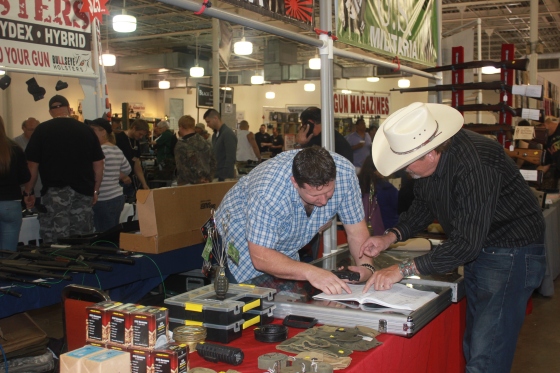
SPECIAL TO THE FLORIDA COURIERGun Show

As reported in this series, 26-year-old Jimmy Jackson was shot on June 2, 2012, at the Silver Fox nightclub while working part-time as road manager for rap artist Young Cash, a protégé of popular Florida-based rapper Flo Rida.James Jimmy Jackson, III Headshot (1)

The former Florida A&M University business student died 10 days later at Shands Hospital, leaving his supportive family shocked and grieving. His five-year-old daughter Denia no longer has a daddy to tuck her in at night. He won’t cheer at her college graduation, or walk her down the aisle on her wedding day.

Four bullets
Jacksonville Detective Bobbie Bowers, the lead homicide investigator, is calling Jackson’s tragic shooting a random robbery.

Two Black males wearing dark clothing approached Jackson in a pitch-dark parking lot at close to 4 a.m.

He complied with their request for money, but assailants still pumped four bullets into his 6’1” athletic frame as he walked away.

Older brother Anthony Rozier said that Jackson refused to carry a concealed weapon, as is possible under Florida’s liberal ‘concealed carry’ law.

“I don’t need a gun, cause I ain’t gon’ shoot nobody,” Jackson told Rozier.

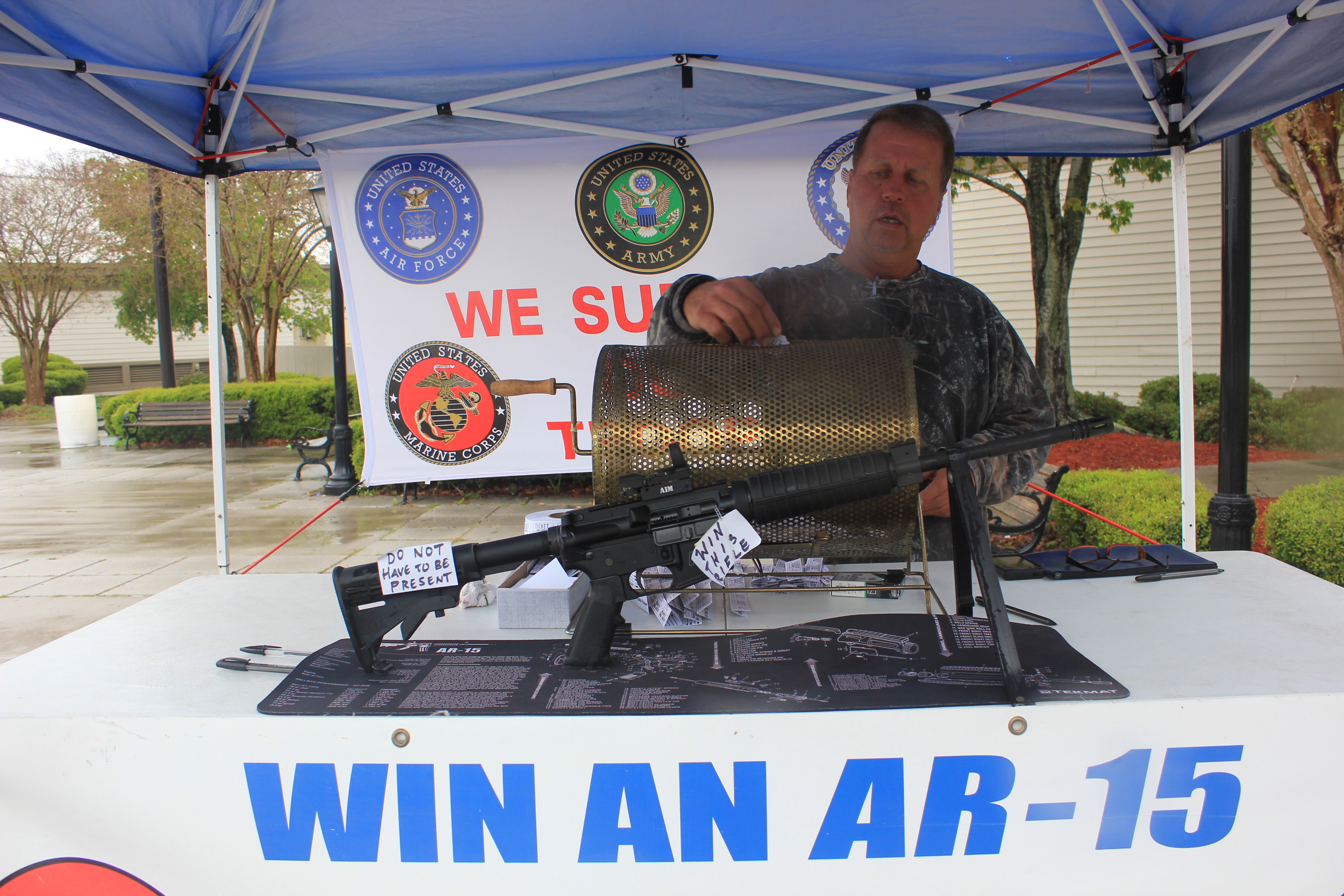
Win an AR-15

William “Bill” Burns holds a monthly raffle to win an AR-15 rifle. Proceeds benefit his nonprofit organization “Dream Hunts For Heroes.”
(PHOTOS COURTESY OF PENNY DICKERSON/FLORIDA COURIER)

Millions with guns
There’s no proof that Jackson would still be alive if he had been carrying a gun, but a record number of citizens do plan to shoot whenever necessary. One of every 17 Floridians – more than a million people just in Florida alone – has a license to carry a concealed firearm.

While homicide rates are down, Florida is home to the largest number of gun-carrying permits in the country, giving the peninsula an unsavory moniker: “the Gunshine State.” Continue Reading »

Leave a comment

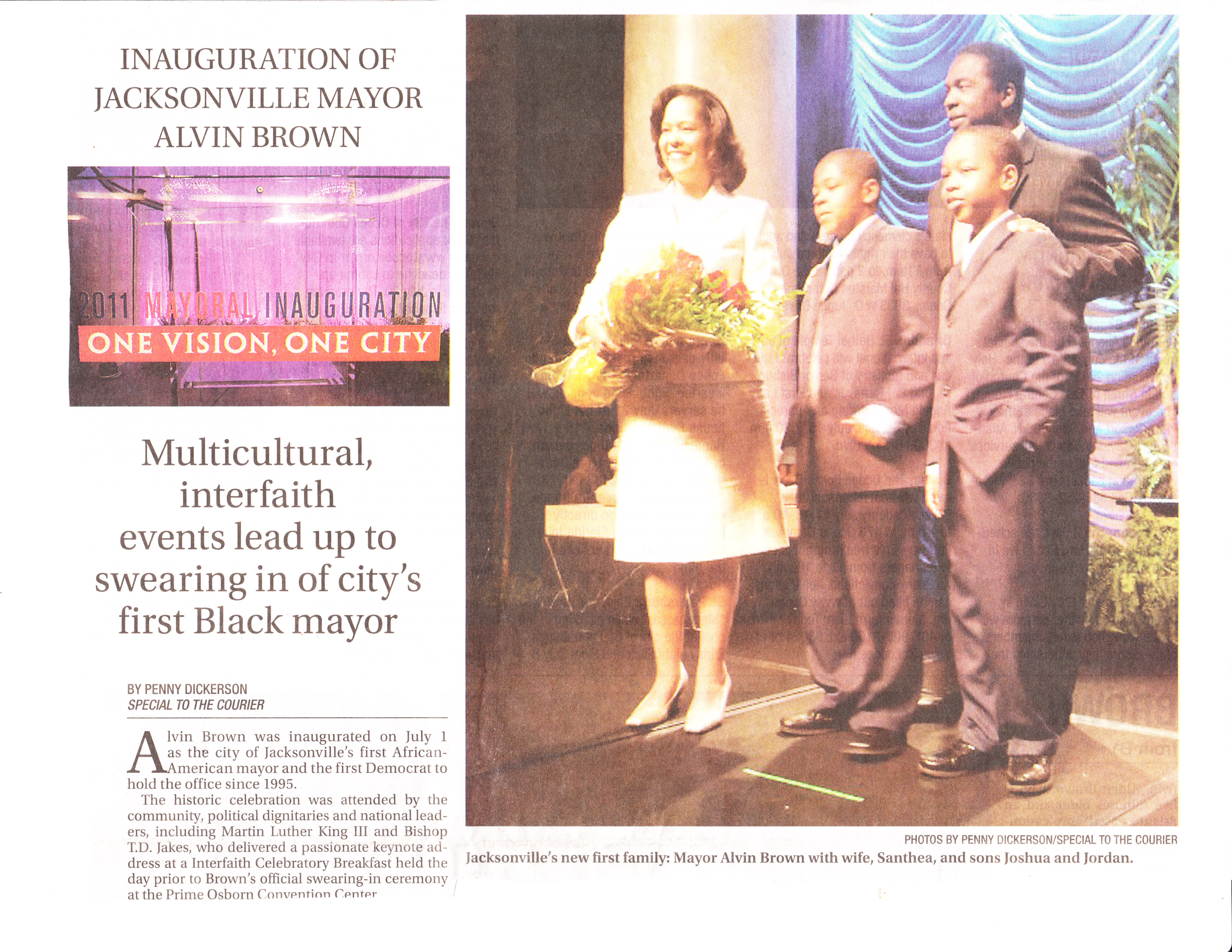
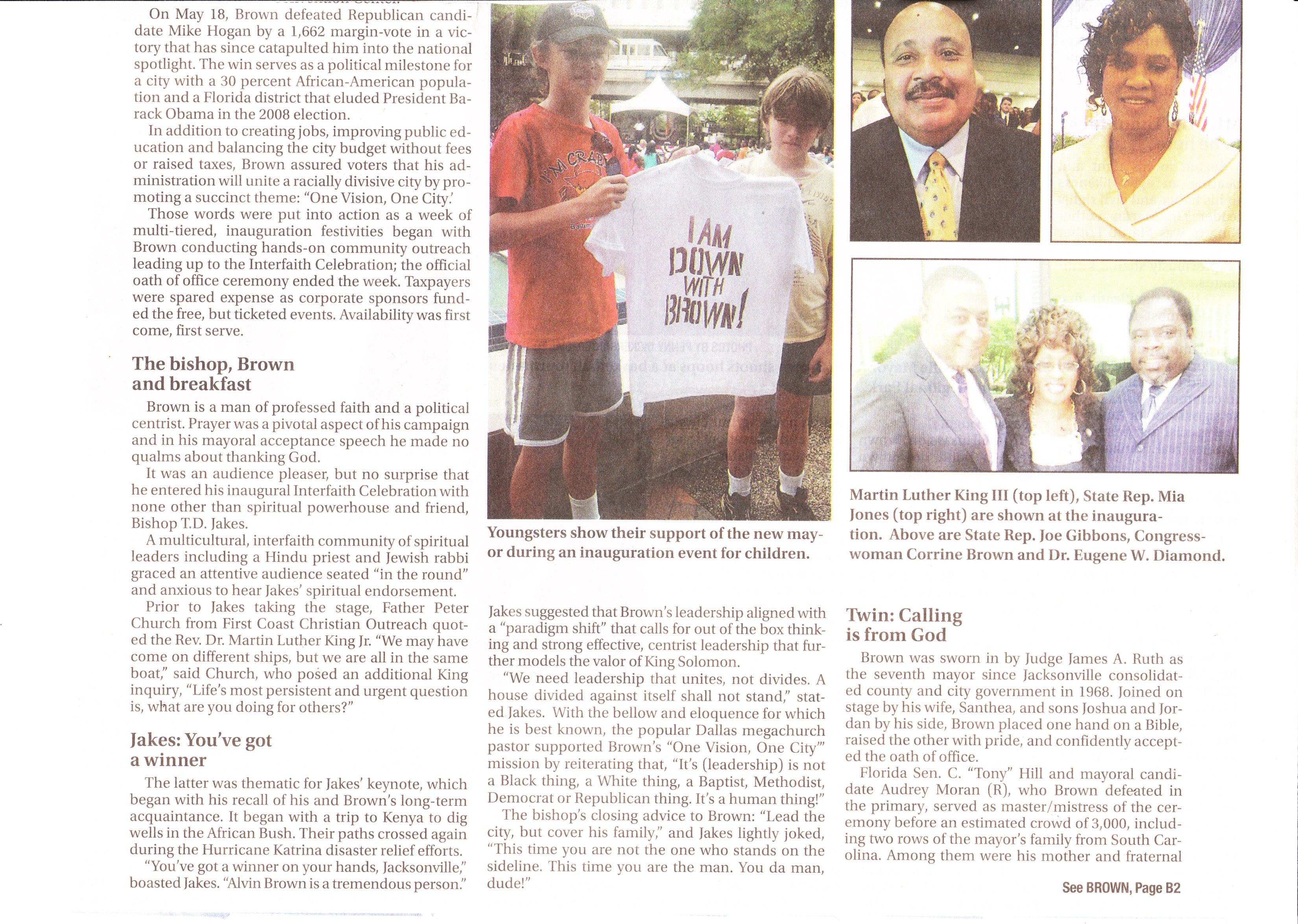
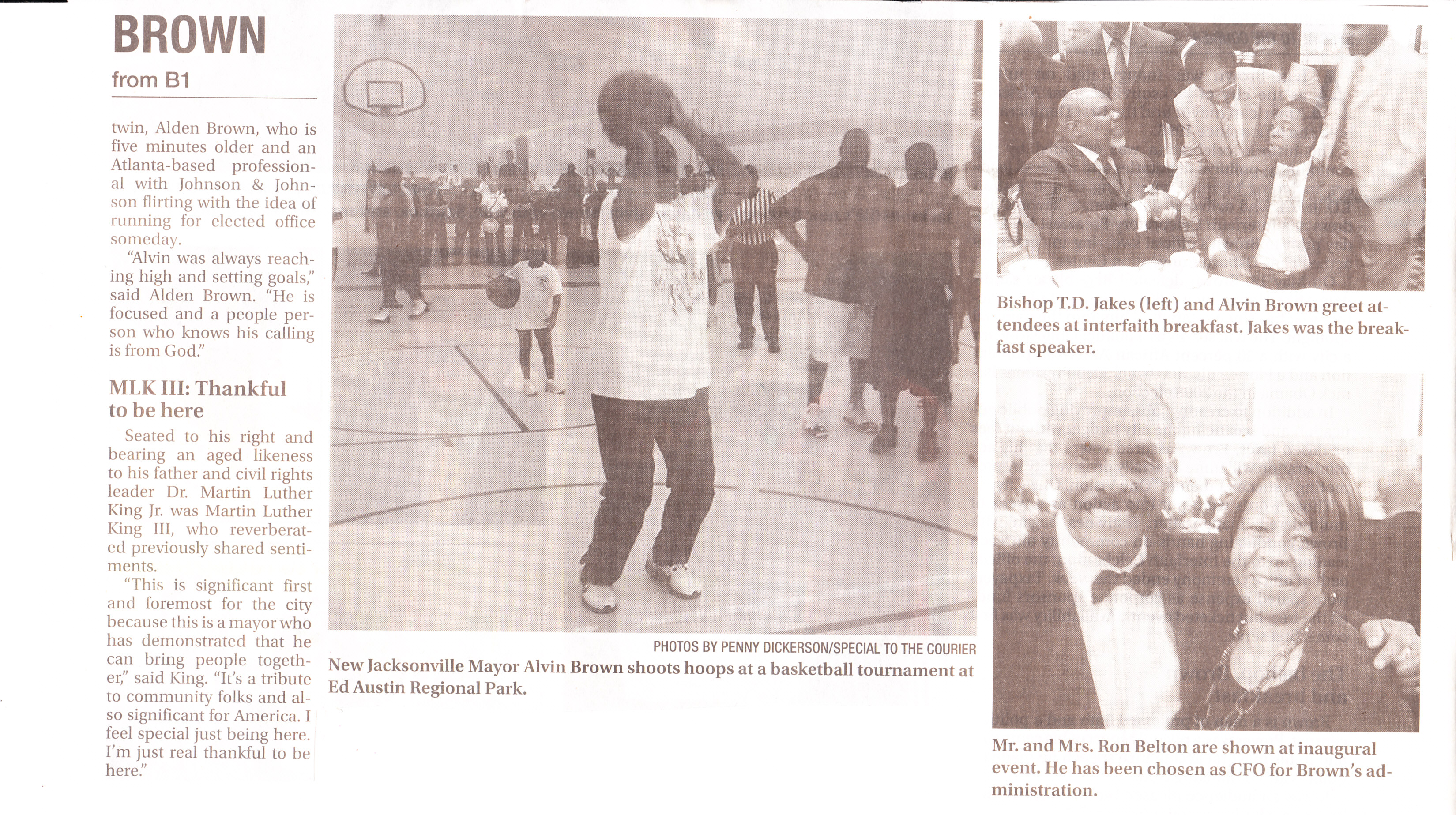
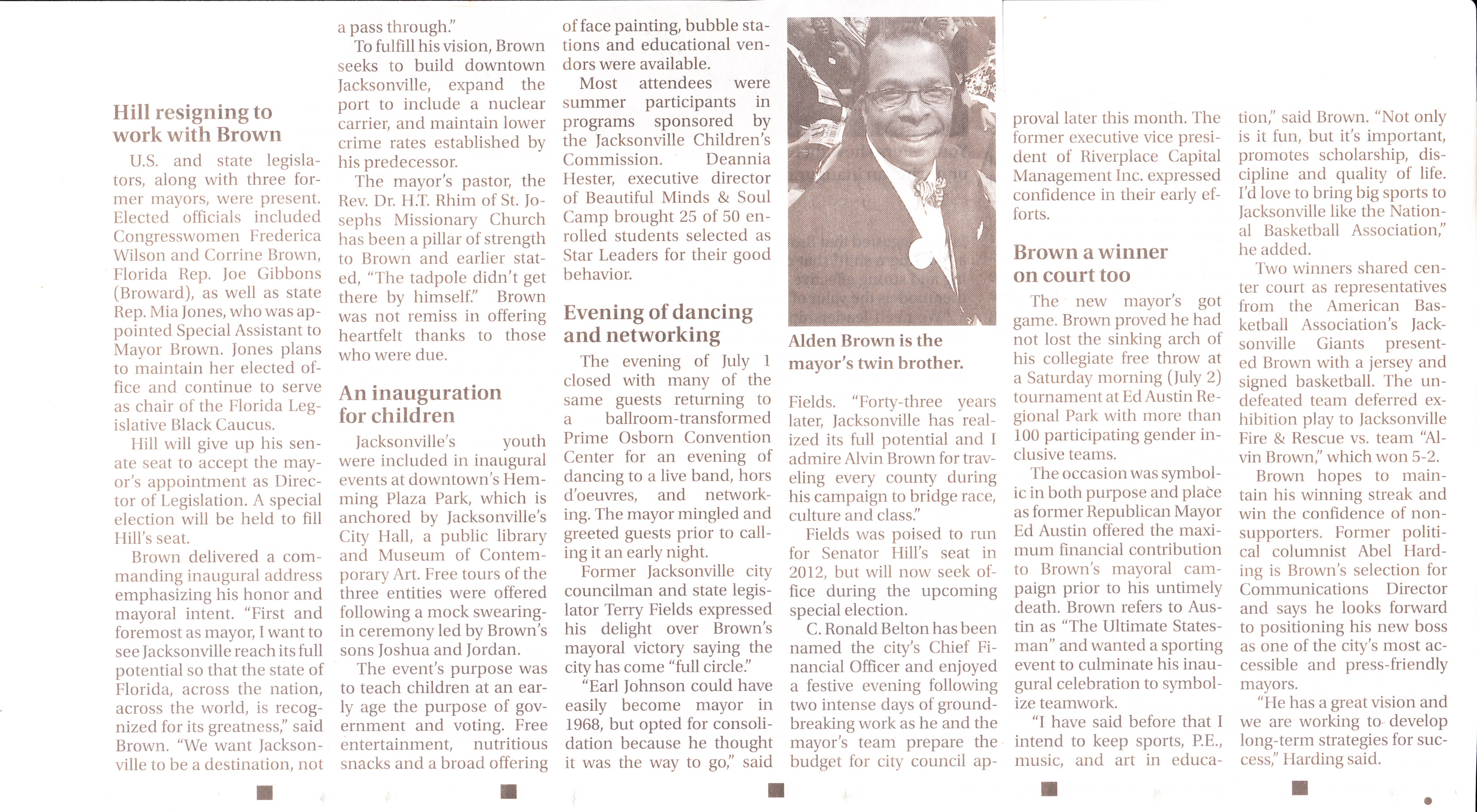
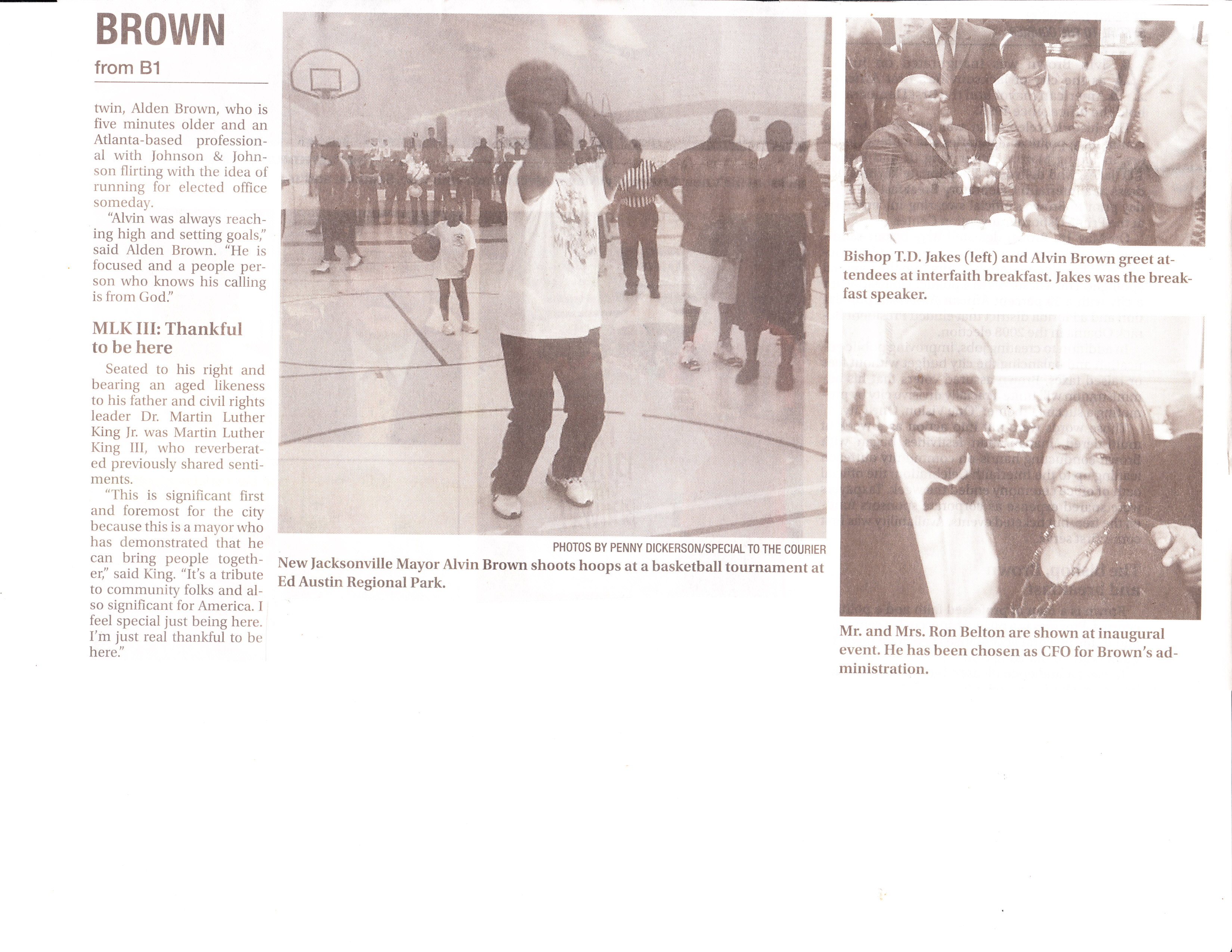
Jacksonville Inaugurates Mayor Alvin Brown

Click link to read complete story

http://flcourier.com/2012/05/10/one-vision-one-city-jacksonville-celebrates-inauguration-of-its-first-black-mayor-alvin-brown/